
AI Design Platforms vs Traditional Design Agencies — When to Use Each
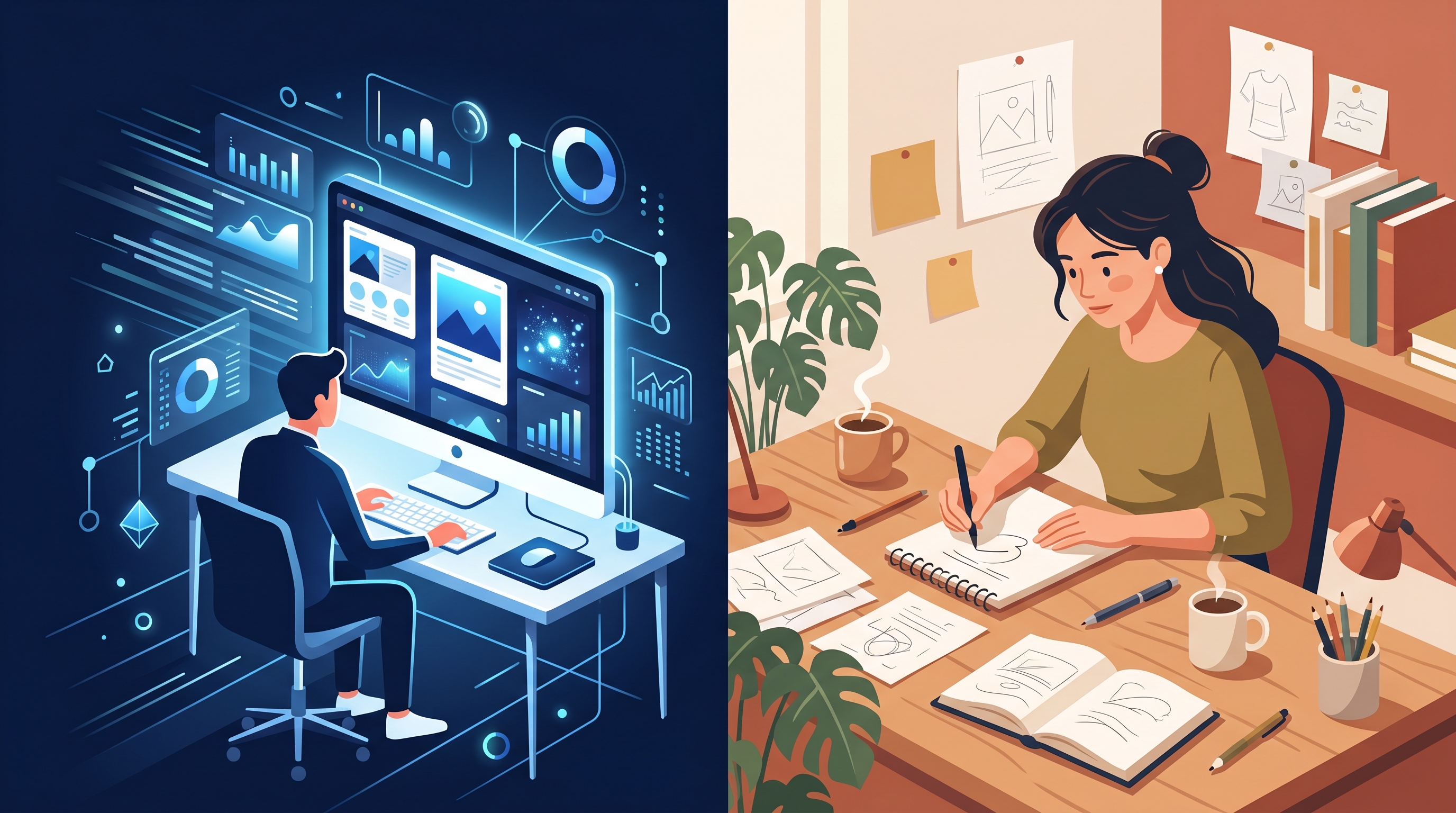
AI design platforms and traditional design agencies solve different problems: use an AI platform for speed, volume, and daily on-brand content at low cost, and use an agency for brand strategy, bespoke campaigns, art direction, and high-stakes creative. Choosing between AI design vs a design agency isn't about which one "wins" — it's about matching the tool to the job. The smartest teams in 2026 use both, and increasingly the same platform bridges them. This guide gives you a clear decision framework for when to hire a design agency, when a design agency alternative makes more sense, and how to combine them without overpaying.
The real difference: strategy vs throughput
A design agency is a team of strategists, art directors, and senior designers who think about your brand holistically. They're built for depth: positioning, big-idea campaigns, custom illustration, motion work, and the kind of art direction that takes a brand from "fine" to "memorable." That depth is genuinely hard to replicate, and it's why agencies remain the right call for high-stakes work.
An AI design platform is built for throughput. It generates on-brand creative — posters, social posts, carousels, ad variations, captions — in seconds, from a stored brand profile. It doesn't replace strategic thinking, but it removes the production bottleneck that makes agencies slow and expensive for everyday output.
Put simply: an agency is excellent at deciding what your brand should say and how it should look at the top level. An AI platform is excellent at producing that look at volume, every day, without a new quote each time.
Where agencies genuinely win
Be honest about this — agencies aren't a legacy option you're "upgrading" away from. They lead in:
- Brand strategy and positioning — the foundational thinking before any pixel exists.
- Bespoke, complex campaigns — integrated launches with a unifying creative concept.
- Art direction and original craft — custom illustration, photography direction, distinctive visual identity.
- Packaging and print — physical products, dielines, print production, material specs.
- High-stakes creative — a rebrand, a flagship campaign, anything where a miss is costly.
Where AI design platforms genuinely win
AI platforms lead where the work is high-volume, fast-turnaround, and repetitive:
- Speed — concepts in seconds instead of days-long revision cycles.
- Daily social content — the feed never stops; agencies aren't priced for it.
- Iteration and volume — twenty ad variations to test, not three.
- Cost — predictable monthly pricing instead of per-project invoices.
- Consistency at scale — a stored brand kit keeps colors, fonts, and logo correct on every asset automatically.
A decision framework: which fits your scenario
Use the scenario as the deciding factor, not a blanket preference. Here's how common situations map.
| Scenario | Better fit | Why |
|---|---|---|
| Full rebrand or new visual identity | Design agency | Needs strategic art direction and bespoke craft |
| Daily Instagram, LinkedIn, and TikTok posts | AI design platform | High volume, fast turnaround, low cost per asset |
| Flagship product launch campaign | Agency (with AI for the volume assets) | Big creative idea from agency; platform produces the many sizes |
| 30 ad variations for A/B testing | AI design platform | Speed and iteration matter more than bespoke craft |
| Packaging, print collateral, signage | Design agency | Print production and physical specs need specialist craft |
| Repurposing one blog post into 10 social graphics | AI design platform | Templated, on-brand, repeatable production work |
| Annual report or pitch deck design | Agency or hybrid | Depends on stakes; AI handles routine slides, agency the hero pages |
| Filling a content calendar consistently | AI design platform | Throughput and brand consistency, not one-off creativity |
The pattern is clear: hire an agency when the work is strategic, bespoke, or high-stakes; use an AI platform when it's high-volume, fast, and on-brand-repeatable.
The hybrid model: AI-instant plus human-polish
The cleanest answer for most teams isn't "agency or AI" — it's a platform that does both. Meepo is built on an AI-instant, human-polished model: AI generates on-brand concepts in seconds from your brand kit, and on agency plans, senior human designers refine those concepts within 24 hours. You get the throughput of automation and the craft of a designer in one workflow, without juggling two vendors.
This matters because the false choice — pay agency rates for everything, or accept generic AI output for everything — is exactly what wastes budget. A human-in-the-loop workflow lets AI handle the 80% of routine production and reserves human craft for the 20% that needs it.
Here's how the tiers map to real needs:
| Need | Meepo plan | What you get |
|---|---|---|
| Try it, solo creator | Free ($0) | 20 credits, 1 brand, no credit card |
| Steady solo output | Creator ($8/mo) | Ongoing on-brand generation |
| Brands + AI video | Pro ($20/mo) | 3 brands, AI video generation |
| Small team volume | Team ($100/mo) | 5 brands, team workflows |
| AI + human designer | Essential ($199/mo) | 30 human design requests/mo, 24h turnaround |
| Agency-grade polish | Premium ($699/mo) | Higher-volume human design support |
As a rule of thumb, generation runs roughly 1 credit per image, about 6 credits for a 6-slide carousel, and 13–19 credits per video — so you can estimate output against a plan before committing.
How to actually decide, step by step
- List your recurring design work for a month. Separate it into "strategic/bespoke" and "high-volume/repeatable" — this split usually decides the tool for you.
- Send the strategic, high-stakes items to an agency (or an agency plan). Rebrands, flagship campaigns, packaging — pay for craft where a miss is expensive.
- Route the high-volume, daily items to an AI platform. Social posts, ad variations, blog repurposing — automate the throughput and keep brand consistency on autopilot.
- Set up a brand kit once. Loading your colors, fonts, and logo means every generated asset is on-brand without re-briefing. See building a brand kit from scratch.
- Use a hybrid plan for the gray-area work. Pieces that need volume and polish are exactly what AI-instant, human-polished plans are for.
- Review cost per asset quarterly. If your agency invoices are dominated by routine production, that's the work to shift to a platform.
When NOT to replace your agency
A design agency alternative isn't always the right move. Keep the agency lead when: you're defining brand strategy for the first time; the creative concept is the differentiator (not the execution); you need print or physical production; or the cost of a mediocre result is high. In those cases, an AI platform is a complement — it produces the supporting volume around the agency's hero work, not a substitute for the thinking.
The teams that overspend treat every asset as agency-worthy. The teams that look cheap treat every asset as disposable AI output. The right answer sits between them: strategic craft where it counts, automated on-brand production everywhere else.
If you want to see where the line falls for your own workload, sign up free and run a week of routine content through a platform — then compare it against what that same week would cost in agency hours. For a broader view of how subscription design fits modern teams, see the best AI design subscription services for 2026.
FAQ
Is an AI design platform a real alternative to a design agency?
For high-volume, fast-turnaround, on-brand production work, yes — an AI platform handles daily social content, ad variations, and repurposing at a fraction of agency cost and time. For brand strategy, bespoke campaigns, art direction, and print, an agency still does work an AI tool cannot match. Most teams use both rather than choosing one.
When should I hire a design agency instead of using AI?
Hire an agency when the work is strategic, bespoke, or high-stakes: a rebrand, a flagship launch with a big creative idea, packaging and print, or anything where a poor result is genuinely costly. Agencies bring positioning, art direction, and original craft that justify their rates for those projects. For everyday production, an AI platform is usually the better economic fit.
Can one platform do both AI generation and human design?
Yes. Meepo uses an AI-instant, human-polished model: AI generates on-brand concepts in seconds, and on agency plans, senior human designers refine them within 24 hours. That hybrid lets you automate routine volume while reserving human craft for work that needs it, without managing two separate vendors.
How much can switching routine work to AI design save?
It depends on your volume, but the savings come from moving repetitive production off per-project agency invoices and onto predictable monthly pricing. Meepo plans range from free to 199 dollars a month for AI plus human design support, compared with typical per-project agency quotes for similar output. Review which of your invoices are routine production versus strategic craft to estimate your own savings.
Will AI design hurt my brand consistency?
It does the opposite when set up correctly. A stored brand kit holds your colors, fonts, logo, and guidelines so every generated asset stays on-brand automatically, which is often more consistent than briefing multiple freelancers. The risk to consistency comes from ad-hoc tools without a brand profile, not from AI generation itself.
Do AI platforms handle print and packaging?
Generally no — print and packaging need specialist production craft, dielines, material specs, and color management that remain agency territory. AI design platforms focus on digital creative: social posts, ads, carousels, captions, and video. Use a platform for your digital volume and an agency for physical and print work.
Ready to automate your design workflow?
Try Meepo free — AI generates designs instantly, human designers polish to agency quality.
Start Free