
How AI Design Platforms Handle Multi-Language Content — Arabic, Chinese, and Japanese Text in Graphics
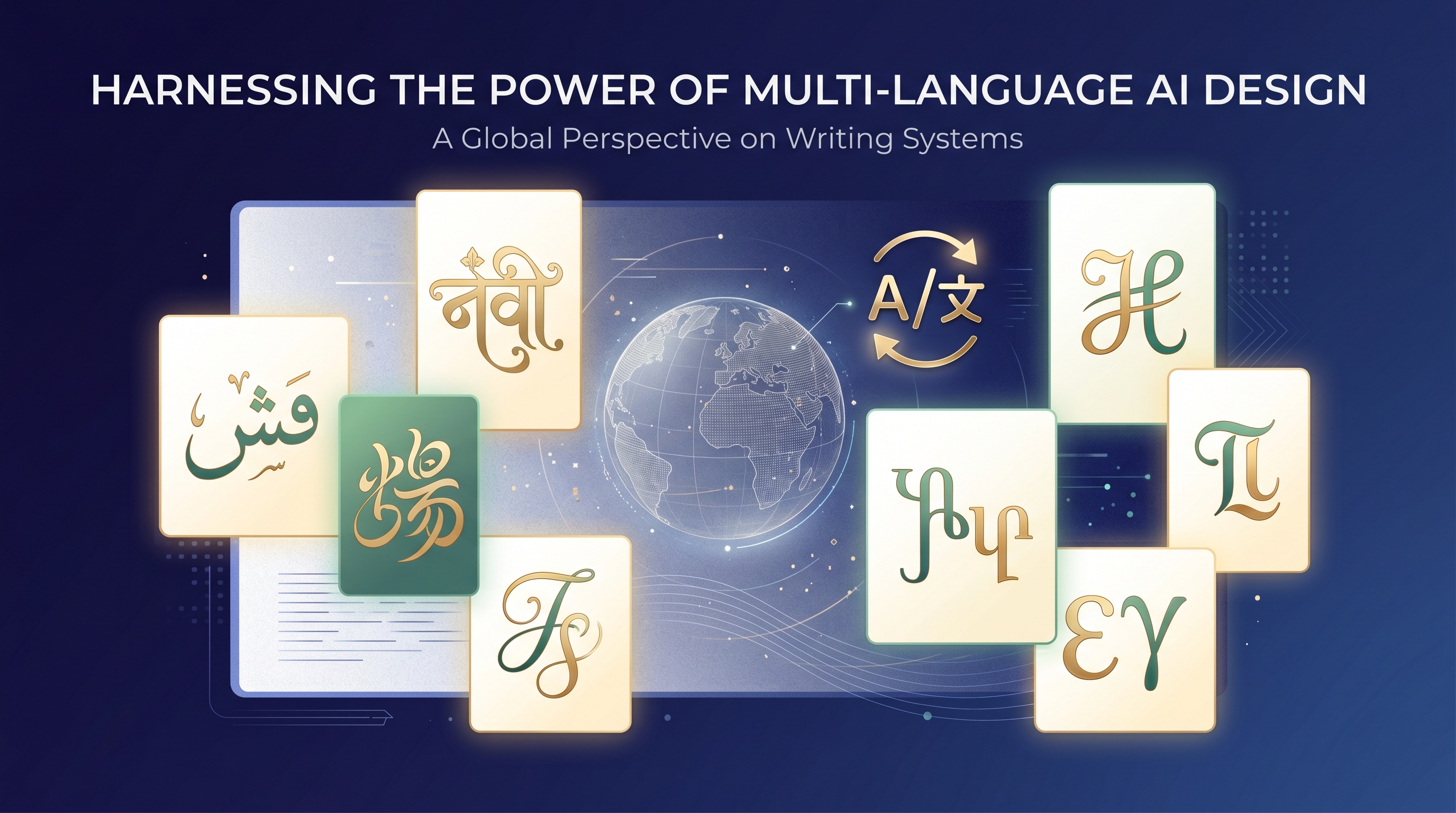
AI design platforms handle multilingual content unevenly: they reliably swap and lay out Latin-script copy and increasingly support common non-Latin fonts, but they still struggle with complex script shaping — Arabic letter joining, right-to-left layout mirroring, and dense CJK line breaking — which is why native review and editable text layers remain essential. For any global marketing team doing AI design multilingual work, the honest summary is this: the tools save enormous time on layout and concepting, but they are not yet a reliable substitute for typographic judgment in Arabic, Chinese, Japanese, or Korean.
This guide walks through the real, script-specific challenges of multi-language graphic design, what today's AI image and design tools actually do well versus where they break, and a practical workflow that keeps your global creative accurate.
Why multilingual design is harder than translation
Translating the words is the easy part. The hard part is that scripts have physical rules — direction, joining, density, and length — that change how a layout must be built. A headline that fits one line in English can overflow a button in German, read backwards in Arabic, or need vertical setting in Japanese. Three problem families show up again and again.
Text expansion and contraction
The same message occupies wildly different space across languages. As a rough rule of thumb, text translated from English commonly expands 20–35% in Romance languages and German, while it often contracts in Chinese. If your layout is sized tightly to English, the translated version clips, wraps awkwardly, or forces an ugly font-size reduction.
Mixing scripts in one asset
Real campaigns mix scripts constantly: an Arabic headline with a Latin brand name, a Japanese caption with English hashtags, a price in Western numerals inside a CJK sentence. Each mix introduces alignment, baseline, and font-pairing decisions that automated tools frequently get subtly wrong.
Glyph coverage
A font that looks great in English may simply not contain Arabic, Chinese, or Korean glyphs. When a glyph is missing, you get tofu (□) or a silent substitution to a mismatched fallback font — a common, easy-to-miss failure in AI-generated graphics where the "text" is sometimes rendered as pixels, not editable type.
Right-to-left scripts: Arabic and Hebrew
RTL is where generic tools struggle most, because correct rendering needs more than reversing character order.
- Text direction. The base paragraph direction must be RTL, and punctuation, list bullets, and quotation marks flip accordingly. Naively right-aligning LTR text is not the same as true RTL layout.
- Cursive joining and contextual forms. Arabic is cursive: most letters change shape depending on whether they sit at the start, middle, or end of a word, or stand alone. Correct rendering requires the shaping engine to select the right contextual glyph and join letters. AI tools that "paint" text as an image routinely produce disconnected or malformed Arabic letterforms — a fluent reader spots it instantly even when a non-reader thinks it looks fine.
- Mirrored layouts. In RTL designs, the whole composition often mirrors: logo and navigation move to the right, progress and arrows point left, image-text order reverses. Mirroring icons that imply direction (arrows, back buttons) matters; mirroring icons that don't (a coffee cup, a clock) is wrong.
Hebrew shares the RTL direction and mirroring needs but is non-cursive, so it avoids the contextual-joining problem that makes Arabic the single hardest mainstream script for AI text rendering today.
CJK scripts: Chinese, Japanese, Korean
CJK introduces a different set of constraints.
- Character density. CJK glyphs are visually complex and read at larger effective sizes; cramming them into a thin Latin-sized text box hurts legibility. Leave more breathing room and line height.
- Line breaking. CJK can break between almost any characters (no spaces), but kinsoku rules forbid certain characters from starting or ending a line (e.g., a closing bracket or a small kana). Tools without proper line-breaking logic produce orphaned punctuation.
- Vertical text. Japanese and traditional Chinese can be set top-to-bottom, right-to-left columns — common in posters and packaging. Most AI design tools have weak or no vertical-text support.
- Font and glyph coverage. CJK fonts are huge (thousands of glyphs) and licensing/coverage varies; Simplified vs. Traditional Chinese are distinct, and Japanese kanji forms differ from Chinese forms for some shared characters. Picking the wrong regional font is a real accuracy bug, not a style choice.
What AI design tools do well vs. where they struggle
Be honest with your team about the current state so expectations match reality.
| Capability | How AI tools handle it today |
|---|---|
| Latin-script copy swaps and layout | Strong — reliable resizing, reflow, and on-brand styling |
| Auto-resizing one design to many formats | Strong — fast multi-format export |
| Common non-Latin fonts (when provided) | Improving — works when the right font is supplied and text stays editable |
| Text expansion handling | Mixed — better with flexible layouts; still needs human spacing review |
| Arabic letter joining / contextual forms | Weak — frequent shaping errors, especially in image-rendered text |
| RTL layout mirroring | Mixed — direction may be handled, but full composition mirroring often isn't |
| CJK line breaking and vertical text | Weak to mixed — vertical text and kinsoku rules are often unsupported |
The throughline: AI is excellent at the layout and production layer and unreliable at the script-shaping layer. Anything where the engine renders glyphs as pixels rather than real, font-backed editable text is the highest-risk zone.
A practical workflow for accurate multilingual design
Use this sequence to get the speed of AI without shipping broken type.
- Design with the longest language in mind. Build layouts that already accommodate +35% text and CJK line height — retrofitting expansion later breaks more than it fixes.
- Supply proper, glyph-complete fonts per script. Confirm the font covers Arabic, Simplified vs. Traditional Chinese, Japanese, or Korean as needed — don't rely on a Latin font's silent fallback.
- Keep text as editable layers, not baked-in pixels. Editable text is correctable; image-rendered text usually isn't. This single choice prevents most shaping disasters.
- Set the correct base direction and mirror RTL layouts. Flip composition, directional icons, and alignment for Arabic and Hebrew — not just text alignment.
- Give every language breathing room. Add padding and avoid tight, fixed-width text boxes so expansion and dense CJK glyphs have space.
- Review with a native speaker before publishing. A fluent reviewer catches joining errors, wrong regional fonts, awkward breaks, and tone issues that no automated check reliably finds.
- Store locale settings in your brand kit. Lock per-market fonts, sizes, and spacing so the next campaign starts correct instead of re-solving the same problems.
Where a platform like Meepo fits: it's an AI-instant, human-polished design platform built around brand profiles that store your fonts, colors, and guidelines, so global teams can generate on-brand posters, social posts, and carousels fast and keep assets editable. On agency plans, senior human designers refine output within 24 hours — useful precisely for the script-shaping cases where automation alone isn't enough. Treat AI as the accelerator and keep a native-speaker review step in the loop for any complex script.
Putting it together: a quick script reference
| Script / Language | Main challenge | Practical tip |
|---|---|---|
| Arabic | Cursive contextual joining + RTL mirroring | Use a real Arabic font with editable text; native review is mandatory |
| Hebrew | RTL direction and layout mirroring | Mirror the whole composition and directional icons, not just alignment |
| Chinese (Simplified/Traditional) | Glyph density; Simplified ≠ Traditional | Pick the correct regional font; increase line height and padding |
| Japanese | Vertical text + kinsoku line breaking | Verify breaks and vertical setting manually; check kanji forms |
| Korean | Glyph coverage; spacing of Hangul blocks | Use a Hangul-complete font and leave generous spacing |
| German / Romance | Text expansion (+20–35%) | Design to the longest string; avoid tight fixed-width boxes |
| Mixed scripts | Font pairing, baseline, alignment | Pair compatible fonts and align baselines per asset |
Done well, AI design lets a small global team produce localized creative in a fraction of the usual time — often turning a multi-day per-market design cycle into the same afternoon. The win comes from pairing that speed with the right fonts, editable layers, layout headroom, and a native-speaker check. Ready to set up brand-consistent, multi-market design? Start free — no credit card required.
FAQ
Can AI design tools write Arabic text correctly?
Partially. They can place and style Arabic when supplied with a proper Arabic font and editable text, but they frequently get cursive joining and contextual letterforms wrong, especially when text is rendered as a flat image rather than real type. A fluent Arabic reader spots these shaping errors immediately. Always review Arabic output with a native speaker before publishing.
Why does my translated text overflow the design?
Different languages take up different amounts of space for the same message. Translations from English often expand by roughly 20 to 35 percent in German and Romance languages, so a layout sized tightly to English will clip or wrap awkwardly. The fix is to design for the longest expected language and leave generous padding and flexible text boxes from the start.
How do I handle Chinese, Japanese, and Korean text in graphics?
Use a font that fully covers the script you need, and remember that Simplified and Traditional Chinese are distinct, as are Japanese kanji forms. CJK glyphs are dense, so increase line height and spacing for legibility, and check line breaks manually because punctuation rules differ from Latin scripts. For vertical Japanese or Traditional Chinese layouts, verify the setting by hand since many tools support it poorly.
What is the most important best practice for multilingual AI design?
Keep your text as editable layers rather than pixels baked into an image. Editable text can be corrected when an AI tool makes a shaping, spacing, or font error, while image-rendered text usually cannot. Combined with a native-speaker review step, editable text prevents the large majority of multilingual design mistakes.
Does Meepo support multilingual and right-to-left design?
Meepo is an AI design platform built for on-brand creative, with brand profiles that store your fonts and guidelines, which helps global teams stay consistent across markets. As with any AI design tool today, complex scripts such as Arabic and CJK benefit from a native-speaker review, and Meepo's agency plans add human designer refinement within 24 hours for cases that need it. Use proper per-script fonts and editable text for the best results.
Should I trust AI to fully localize a campaign without review?
No. AI is excellent at layout, resizing, and producing on-brand variations quickly, but it is not yet reliable at complex script shaping, regional font selection, or tone. Treat AI as an accelerator that does the heavy production work, then add a native-speaker check before anything goes live. This keeps the speed advantage while protecting accuracy and brand quality.
Ready to automate your design workflow?
Try Meepo free — AI generates designs instantly, human designers polish to agency quality.
Start Free